

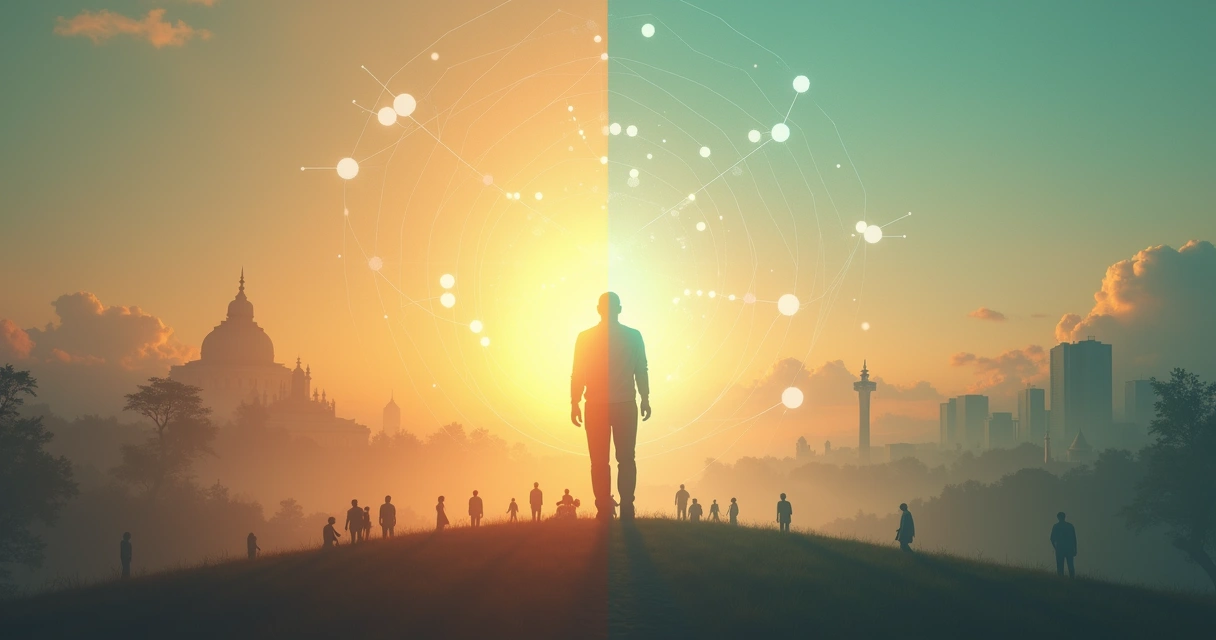
Questions about meaning, purpose, and the nature of human experience have guided spiritual seekers and philosophers for centuries. Today, we see a surge in people seeking spiritual connection outside of traditional frameworks, as confirmed by recent Pew Research Center surveys reporting that 70% of U.S. adults describe themselves as spiritual, and 22% emphasize spirituality separate from religion. But how do new approaches differ from the old? We believe the distinction between Marquesian philosophy and traditional spiritual models reveals a new pathway for integrated, conscious development, focused on real-world engagement and deeper internal coherence.
The foundations of Marquesian philosophy
Marquesian philosophy emerged from decades of lived practice. Unlike systems based on fixed dogmas or strict traditions, we root our approach in the dynamic unfolding of consciousness in everyday life. Rather than focusing on abstract theorizing, we aim for direct experience and applicable knowledge. This orientation shapes not only how we perceive consciousness, but also how we understand emotion, personal action, and meaning.
- Consciousness is not set apart from the world, but actively woven into it.
- Meaning evolves through responsible choice, presence, and engagement with reality.
- Reason, emotion, and a sense of connectedness each play a part in a balanced life.
We see the human being as a living, maturing system, where integration is key – not separation or detachment.
Traditional spiritual models: key characteristics
By traditional, we refer here to models that have developed over centuries and often emphasize transcendence, spiritual disciplines, or escape from the ordinary. These models often share the following characteristics:
- Strong structures or rituals that guide daily life
- Emphasis on belief, faith, or obedience to sacred stories or teachings
- Hierarchical transmission of knowledge through teachers or authorities
- Spiritual practices focused on reaching states beyond normal experience
For many, such systems foster belonging and stability. But research on spiritual practices and beliefs finds that growing numbers seek approaches less tied to institutional forms, looking instead for authenticity, inner growth, and direct experience.
True transformation is found in embodied awareness, not in separation.
Integration of consciousness, emotion, and action
One of the most distinctive features we see in Marquesian philosophy is the integration of the inner and outer world. While traditional spiritual models often value withdrawal from ordinary life to reach higher states of consciousness, we affirm that maturity grows from engagement, self-observation, and the harmonization of daily choices with deeper awareness.
This integration comes to life in several ways:
- Developing emotional intelligence and self-regulation as a spiritual practice
- Examining unconscious patterns that shape behaviors and relationships
- Taking personal responsibility for meaning and actions, beyond external rules
- Applying meditation, not as escape, but as a tool for clarity and presence in all moments

The goal is not detachment, but fuller presence with clarity and balance.
Understanding human development and maturity
Traditional spiritual systems often anchor development in following a path of prescribed virtues, progressing through levels or tests set out by the tradition’s framework. These systems sometimes treat spiritual development as a linear ascent away from ordinary life, promising an ultimate state separate from the world and from ordinary emotion. But does this match human experience?
We conceive of development as a spiraling process, always rooted in our current reality and relationships. This includes:
- Recognizing and working with our emotional pain points and unconscious patterns
- Seeing maturity as a dynamic process, not a static final end
- Connecting our personal transformation with our impact on others and our environment
Our focus is on responsible self-leadership and consistent growth – not on proving spiritual superiority or escaping challenge.
Systemic perspective on human relations
Another notable difference lies in the perspective on relations and systems. Marquesian philosophy invites us to see how we are shaped by invisible patterns within our families, organizations, and communities. Traditional spiritual models may identify karma, sin, or fate as governing forces, but rarely offer practical maps for seeing how intergenerational and systemic dynamics influence our daily choices.
Through systemic awareness, we are called not only to individual healing but to conscious participation in the greater whole. As we unpack these patterns, new paths open for both personal and collective healing. For a deeper understanding of these dynamics, our section on systemic constellations may provide useful perspectives.
Change in one part of the system ripples through every relationship.
Valuing humanity and responsible action
For us, the value of a philosophy or spiritual approach is measured by its contribution to real life. We see the worth of a person not only in their abstract spiritual achievements, but in their ethical choices, their impact on others, and the sustainability of their actions. In contrast, traditional models often focus on achieving personal enlightenment or reaching salvation, sometimes missing the link between awakening and practical responsibility.
This expanded valuation involves
- Integrating consciousness and ethics in decision-making
- Nurturing leadership skills grounded in presence and empathy
- Connecting personal purpose with social and environmental awareness
For those interested in this topic, our category on integrative human valuation details these principles further.

Direct application: meditation, psychology, and daily living
Marquesian philosophy does not separate inner practices from outward living. We connect self-observation, meditation, and psychological understanding as tools for increased presence and healthy relationships. For instance:
- Marquesian meditation focuses on internal order and conscious involvement – applicable even in the busiest moments
- Practical psychology models reveal patterns that shape behavior, informed by emotional maturity rather than diagnosis or doctrine
- Meditation, according to recent studies, is sought by many to feel more connected to their “true self” or something larger; our approach roots this in daily commitment
To learn more about integrating these insights into real life, our articles on applied psychology and contemporary meditation explore daily practice in depth.
Conclusion: The difference is in integration and presence
When we compare Marquesian philosophy to traditional spiritual models, a clear difference stands out. Traditional models often point toward separation from ordinary life and fixed teachings, while we ground transformation in daily experience, integration, and personal responsibility. For us, maturity does not come from withdrawing from the world or following a rigid path, but from relating to life with full awareness, emotional clarity, and conscious action, inside and out. This approach opens the door for a constant process of real growth – one in which we can all take part.
Frequently asked questions
What is Marquesian philosophy about?
Marquesian philosophy is a contemporary approach to human understanding and development that integrates consciousness, emotion, and responsible action in daily life. The goal is to promote authentic transformation through presence, clarity, and ethical engagement with oneself and the world, rather than focusing on abstract theories or detachment from reality.
How does it differ from traditional spirituality?
Unlike traditional spiritual models, which may emphasize withdrawal from the world or strict adherence to rituals and teachings, Marquesian philosophy brings together introspection, emotional maturity, and systemic awareness for practical application. The focus is on direct personal experience and ongoing integration, not on transcending ordinary life or following a static doctrine.
Is Marquesian philosophy still practiced today?
Yes, Marquesian philosophy is practiced and taught as a living approach. It is adapted continuously to new contexts and personal realities, making its principles accessible for modern individuals, leaders, and organizations interested in ongoing development, awareness, and responsible evolution.
What are the basic beliefs of Marquesian philosophy?
The basic beliefs include the integration of consciousness with ethical action, the interplay of emotion and meaning, and the commitment to growth through real-life engagement. There is an emphasis on observing and transforming unconscious patterns, fostering emotional regulation, and connecting personal purpose with broader human and systemic impact.
How to learn more about Marquesian philosophy?
To learn more, readers can explore resources connected to consciousness, human development, meditation, psychology, systemic constellations, and integrative human valuation. These categories offer insights, practical tools, and guidance for applying the principles of Marquesian philosophy.